Review
I recently read Four Views on Hell, which introduced me to the three main Christian views of the afterlife and hell:
- Eternal Conscious Torment (ECT) : unbelievers will be tortured for eternity outside of God’s presence, while believers will spend eternity in heaven with God
- Annihilationism/Terminal Punishment: unbelievers will be tortured in hell for a period of time, then permanently “annihilated” (i.e. removed from existence)
- Christian Universalism: unbelievers will be tortured in hell for a period of time, then re-joined with God and spend eternity in heaven
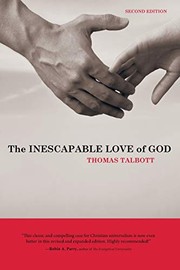
I grew up in a Christian tradition that taught ECT, but I’ve been exploring this topic recently to try and make an informed decision. Thomas Talbott’s The Inescapable Love of God exists to primarily defend the last view, that of Christian Universalism, or as it’s sometimes called, Universal Reconciliation. Talbott plays on commonly-held intuitions among humans, even Christians, about God. In many ways, he plays on the same intuitions that drive the Problem of Evil (why does evil exist if God is good?) and the Problem of Divine Hiddenness (why does God hide himself?).
Overall, I enjoyed The Inescapable Love of God. Even if Talbott doesn’t do anything particularly new in this book, he builds on timeless ideas of God and goodness to provide what I think is ultimately a fairly convincing argument in favor of Universalism. In particular, there were 3 points that stood out to me:
- Most people have the intuition that God is good, and that he wants everyone to go to heaven. Talbott just connects the dots: if God really wants that, then surely he will do what he wants, right?
- The Bible plainly says that 1) God wants everyone to go to heaven, and 2) he is powerful enough to accomplish that, but 3) some people will not go to heaven. Those 3 propositions cannot all be true. At least 1 of them must be re-interpreted. Most Christians reject premise #1, and Universalism rejects #3. In this way, he levels the playing field between the various positions.
- In order to make sense of the Bible, everyone must re-interpret some verses to make them fit with others.
See, for example, how John Piper (a very popular Christian author who is pro-ECT) plainly and comfortably states that God does not will that all are saved.
What stops him [God] from saving some is, in fact, ultimately his own sovereign will. ‘In order that the purpose of God according to election might remain’ he loved Jacob and hated Esau (Rom 9:12, 13). Therefore, I also accept the inference that there are people who are not the objects of God’s electing love.
— John Piper
My intuitions about God point me towards an ultimately loving presence. I agree with Talbott that Christian Universalism clearly has the benefit of philosophical superiority over other theories of hell. Ultimately, I think Talbott has to work against the plainest reading of scripture to make his points, and for that reason, Universalism will not see the support of mainstream Christianity. Most of Talbott’s rebuttals against pro-ECT scripture boils down to “well technically that verse has a little wiggle room for my interpretation, thus Universalism is still consistent with this verse”.
But when I combine verses like Ezekiel 33:11 and 1 Timothy 2:3-4 with my internal intuitions of God (whom I believe to be good and loving), views like ECT or even Annihilationism just fail to make sense to me. As a skeptical theist, and as someone who tries to maintain intellectual humility about most things, this is very clearly not a black and white issue; it’s something I’ll be thinking about and wrestling with for a while. I am willing to commit myself to “hopeful Universalism” but no further for now.
Say to them, ‘As surely as I live, declares the Sovereign Lord, I take no pleasure in the death of the wicked, but prefer that the wicked change his behavior and live. Turn back, turn back from your evil deeds! Why should you die, O house of Israel?’
— Ezekiel 33:11, NET
Such prayer for all is good and welcomed before God our Savior, since he wants all people to be saved and to come to a knowledge of the truth.
— 1 Timothy 2:3-4, NET
I’ve summarized some of my notes below.
The Pit
This is not from the book at all, but I think it’s worth mentioning: in my opinion, one of the strongest arguments for Universalism comes from Josh Rasmussen. I’ve paraphrased it below. The argument is simply a story that plays on your intuitions about how a good God should operate.
Imagine you are building a playground for your children. You have infinite money, infinite time, infinite creativity— you can build any kind of playground that you want. You can pick from all sorts of fun buildings, types of mulch, set the dimensions of the playground— literally anything you want.
Among the infinite possibilities of customizations for your playground, we can imagine one possible playground feature, which I’ll call The Pit.
At first glance, The Pit is just a big black hole in the ground. But The Pit is more special than that: if one of your children falls into The Pit, they will be stuck there forever, falling infinitely, experiencing maximal pain, and eternally screaming out to you for relief. Another quality of the pit is that you cannot ever provide relief to children who fall into The Pit (it’s your playground, so you can make the rules— this is just one possible thing to put in the playground). There is no escape from The Pit, just eternal torture. We can also imagine, perhaps, that The Pit emits a airborne chemical that attracts children to get very close to it and rewards that behavior with a hit of dopamine. Or, maybe The Pit appears like something nice, like a trampoline, until the child falls in— at which point the torture begins.
Thoughts About The Pit
It seems completely unethical to put The Pit into your children’s playground. I mean, you could have made any playground you wanted! An infinite ball pit! A bouncy castle made of candy! And yet, it seems that God made the decision to put The Pit (or something very close to it) into the playground he designed for his children. That kind of decision violates almost every intuition I have about what is “good”, and it’s very hard to understand how God sees this as “good”.
This argument is emotionally powerful, but has the same weaknesses as many arguments related to God: it relies on us applying our moral intuitions to God. One can very easily wave away these strange behaviors with something like “God behaves in mysterious ways” and appeal to God’s transcendence: should we really expect him to behave according to our expectations? It’s a fair question.
The Trilemma
Talbott powerfully argues that the Bible presents the following three statements as fact— but if they are all correct, they create a logical inconsistency.
- All human sinners are equal objects of God’s redemptive love in the sense that God, being no respecter of persons, sincerely wills or desires to reconcile each one of them to himself and thus to prepare each one of them for the bliss of union with him.
Click here to see supporting verses...
-
The Lord is not slow concerning his promise, as some regard slowness, but is being patient toward you because he does not wish for any to perish but for all to come to repentance. (2 Peter 3:9, NET)
-
Such prayer for all is good and welcomed before God our Savior, since he wants all people to be saved and to come to a knowledge of the truth. (1 Timothy 2:3-4, NET)
-
Say to them, ‘As surely as I live, declares the Sovereign Lord, I take no pleasure in the death of the wicked, but prefer that the wicked change his behavior and live. Turn back, turn back from your evil deeds! Why should you die, O house of Israel?’ (Ezekiel 33:11, NET)
- God will triumph in the end and successfully reconcile to himself each person whose reconciliation he sincerely wills or desires.
Click here to see supporting verses...
-
In Christ we too have been claimed as God’s own possession, since we were predestined according to the purpose of him who accomplishes all things according to the counsel of his will (Ephesians 1:11, NET)
-
“I know that you can do all things; no purpose of yours can be thwarted; (Job 42:2, NET)
-
Our God is in heaven. He does whatever he pleases. (Psalm 115:3, NET)
- Some human sinners will never be reconciled to God and will therefore remain separated from him forever.
Click here to see supporting verses...
-
And these will depart into eternal punishment, but the righteous into eternal life.” (Matthew 25:46, NET)
-
They will undergo the penalty of eternal destruction, away from the presence of the Lord and from the glory of his strength, (2 Thessalonians 1:9, NET)
-
For you can be confident of this one thing: that no person who is immoral, impure, or greedy (such a person is an idolater) has any inheritance in the kingdom of Christ and God. (Ephesians 5:5, NET)
Each of these statements has clar prima facie biblical support. But to untangle the trilemma’s knot, the reader must deny at least one of these premises. Talbott categorizes Christians based on which they deny:
- Augustinianism denies #1; God does not want to reconcile all people to himself. God wills some humans to be saved, and others to suffer in hell forever.
- Arminianism denies #2; God wants to reconcile all, but ultimately he cannot make it happen (e.g. because he must respect the free will of humans).
- Universalists reject 3; God wants to reconcile all, and and will make it happen; no single human will be apart from God forever.
I found the layout of this problem to be extremely helpful in understanding these 3 positions. I completely agree with Talbott that, sometimes, the systematic theologian must learn to twist Scripture to mean what the reader wants it to mean; as Dan McClellan sometimes puts it, they must “tell the Bible what it is and is not allowed to say.” I recently wrote about this.
As an example, ironically, I will point to an interpretation of Talbott provides in this book. In Romans 9, Paul quotes Malachi 1:2-3, explaining that God “hated Esau”, one of Jacob’s brothers. This is obviously a problematic verse for Christian Universalism, which must posit that God loves all (as some other verses state, to be fair). So, Talbott merely explains that: well, yes, it says that God “hated Esau”, but God didn’t actually hate Esau, he just hated the bad things in Esau.
…God’s love for Jacob is no different, in that respect, from his so-called hatred of Esau. For surely, God’s “hatred” of Esau also implies a rejection of all that is false within Esau, and his “hatred” of Edom requires that he destroy her wickedness forever. So if there is any difference at all between God’s “hatred” and his love, it lies only in this: from a certain human perspective, such as Esau’s perspective in his struggle with Jacob or Edom’s perspective in her struggle with Israel, God’s perfecting love will consume the very thing that, in our present condition, we continue to hold dear.
— Thomas Talbott
I mean… okay? Sure, Talbott’s interpretation is plausible, but it’s just not what the text says. There were a few situations like this, where Talbott is forced to wave away some Scripture whose plain reading betrays his beliefs. But as I’ve stated in the past, I believe that Scripture lacks univocality; in other words, it does not always agree with itself— it’s composed of many authors who clearly had different ideas of God at some points. The only way to approach Scripture as a systematic theologian is to do exactly what Talbott does here, and learn to perform eisegesis a little bit.
The Power Play
As a general principle, I think that when a power structure offers an argument that supports the existence of that same power structure, we should be wary to believe it. For example, we should be (at least initially) suspicious of the truth value of government propaganda— it was written by the thing it was written to support.
For this reason, I believe Talbott makes an interesting argument against ECT: its existence provides literal “fuel for the fire” of religious fervor and support. When you preach ECT to a congregation, it allows you to control with fear. The threat of hell is a very strong motivation. I found a study about “hell anxiety” in religious and non-religious people, and the discussion admits that “a belief in Hell may cause an intense amount of anxiety in a “rational” sense.” Indeed!
Many religious doctrines serve, among other things, a sociological function, and over the centuries the traditional understanding of hell has served one function especially well: it has enabled religious and political leaders to cultivate fear and to employ fear as a means of social control. That more than anything else explains, I believe, why the imperial church came to regard the idea of universal reconciliation as a threat not only to social stability but to its own power and authority as well.
— Thomas Talbott
To be clear, Talbott’s theory does not require some evil council of pastors who secretly gather to discuss the danger of Universalism and its threat to their tithed income. I sincerely doubt that’s what Talbott has in mind, and neither do I. Rather, I think it is completely believable, even likely, that the “mutation” of ECT (Talbott claims it was not the definitive position in the early church) has caused it to spread like a disease. The fact that fear of hell is a powerful motivator should, like government propaganda, cause us to stop and think about the theology long and hard before conceding it.
As further evidence, Talbott points to historical cases, such as Augustine and Calvin, who believed that heresy was extremely dangerous behavior because it had the potential to lead people away from God with eternal consequences. They were willing to use force to prevent “heresy” (i.e. alternative biblical interpretations) from spreading.
But we have shown that Paul was compelled by Christ; therefore the Church, in trying to compel the Donatists, is following the example of her Lord… Wherefore, if the power [of the sword] which the Church has received by divine appointment in its due season, through the religious character and faith of Kings, be the instrument by which those who are found in the highways and hedges—that is, in heresies and schisms—are compelled to come in, then let them not find fault because they are compelled…
— Augustine
…as a matter of historical fact, the organized Christian church has consistently employed the fear of eternal damnation as a weapon against supposed theological error (as determined by self-appointed authorities, of course). It has consistently cultivated in its constituency the fear that those who die in unbelief, or with certain mistaken beliefs, are precisely those whom God will damn eternally in hell… those in the grips of such fear have too often wielded the sword in a sincere effort to protect their loved ones from the tragic consequences, as they have seen it, of error in religious matters.
— Thomas Talbott
Philosophical Issues
Talbott clearly believes that Christian Universalism has the advantage of philosophy. In the latter half of the book, he expounds on the Problem of Evil (why is there evil in the world if God is good?), and why Christian Universalism supposedly solves the problem in the most clean way. But, I wasn’t particularly swayed by his arguments.
I am pretty sure, about as sure as one can be about any metaphysical and philosophical question, that our world is strictly deterministic; many signs— biological and physical— point to this conclusion. Thus, I deny the existence of free will.1 Because I walk into this book (and my faith) from this perspective, it is completely useless to me when Talbott discusses the relationship of free will to hell and the Problem of Evil, and I cannot adequately judge his work in this regard.
In addition to denying free will, I also believe in an omnipotent and omniscient God; thus, it follows that our choices were predetermined by God long before we took a breath, and it also follows that God decided exactly how each life would go. It is not a large leap of logic to also conclude that God could have created a different world, where we made different decisions— i.e., God could custom-build each creature to do accomplish any goal he desires. For example, if God wanted a world of humans without suffering, that is completely within his power.
Talbott apparently does not share my intuition, and tries to argue that, well, we shouldn’t assume that God actually could create creatures to accomplish any goal. For Talbott, God seems to have some sort of restriction about his creation. Of course, he could be correct, but I feel uncomfortable betting against what an omnipotent creator could do.
The Christian reply to the problem of suffering finally comes down to the idea that creation costs something; that is, not even an omnipotent God could create free, independent persons and perfect them as sons and daughters without paying a heavy price, both in terms of creaturely suffering and in terms of his own suffering as well. In no other environment, except one in which innocent victims sometimes suffer temporarily, could God perfect his loved ones and secure supreme happiness for all of them in the future; in no other environment could he achieve his ultimate victory over sin and death and reconcile the entire human race to himself. So God suffers himself and also permits others to suffer as the price he must pay for a worthwhile creation… From the premise that God is able to perfect each of us over an indefinitely long period of time, it simply does not follow, therefore, that he could have started any one of us out in a perfected condition… As I see it, then, an earthly-type environment plays an essential role in our emergence as rational agents, in our beginning to learn the lessons of love, and in laying the groundwork for whatever redemptive activities God may yet bring to fruition in a postmortem realm.
— Thomas Talbott
It should be no surprise, given my views, that I find this argument extremely unconvincing. It feels like exactly the kind of thing Talbott is teaching us to avoid: his pro-Universalism arguments rest on logical conclusions like “if God says he loves everyone, then he loves everyone, and will find a way to save all, no matter what it takes,” but when it comes to the existence of evil, Talbott has no issue discovering arbitrary limits that conveniently squeeze God to fit his mental image. It feels inconsistent.
Problematic Passages
Matthew 25:31-46
“When the Son of Man comes in his glory and all the angels with him, then he will sit on his glorious throne. All the nations will be assembled before him, and he will separate people one from another like a shepherd separates the sheep from the goats. He will put the sheep on his right and the goats on his left. Then the king will say to those on his right, ‘Come, you who are blessed by my Father, inherit the kingdom prepared for you from the foundation of the world. For I was hungry and you gave me food, I was thirsty and you gave me something to drink, I was a stranger and you invited me in, I was naked and you gave me clothing, I was sick and you took care of me, I was in prison and you visited me.’ Then the righteous will answer him, ‘Lord, when did we see you hungry and feed you, or thirsty and give you something to drink? When did we see you a stranger and invite you in, or naked and clothe you? When did we see you sick or in prison and visit you?’ And the king will answer them, ‘I tell you the truth, just as you did it for one of the least of these brothers or sisters of mine, you did it for me.’
“Then he will say to those on his left, ‘Depart from me, you accursed, into the eternal fire that has been prepared for the devil and his angels! For I was hungry and you gave me nothing to eat, I was thirsty and you gave me nothing to drink. I was a stranger and you did not receive me as a guest, naked and you did not clothe me, sick and in prison and you did not visit me.’ Then they too will answer, ‘Lord, when did we see you hungry or thirsty or a stranger or naked or sick or in prison, and did not give you whatever you needed?’ Then he will answer them, ‘I tell you the truth, just as you did not do it for one of the least of these, you did not do it for me.’ And these will depart into eternal punishment, but the righteous into eternal life.”
— Matthew 25:31-46 (NET)
In response to this passage, Talbott makes the argument that, since Jesus’s teachings are sometimes not literal (e.g. Jesus saying we should “hate father and mother”), we can’t assume this “eternal fire” is literal. Talbott does not offer any specific criteria for knowing when a teaching is literal or not. This is technically a fair argument, but without specific evidence that this teaching is not literal, it feels arbitrary to mark it as such.
In addition, Talbott makes a couple of arguments based on the Greek: first, that the Greek term aiōnios is usually translated as “unending” or “eternal”, but it doesn’t necessarily always mean an “unending period of time”. For example, an activity of God is sometimes described as “eternal” despite the action taking place once. Thus, “eternal punishment” could mean “punishment from God, who is eternal”. Second, he says the Greek term kolasis is translated as “punishment” but has a corrective connotation, not merely vindictive. I have little knowledge about Greek and I have no response to Talbott here: he is possibly correct, possibly not.
-
…there are several senses, compatible with New Testament usage, in which an eternal punishment (in the sense of kolasis aiōnios) could still be of limited duration.
— Thomas Talbott
Luke 16:19-31 (ECT)
“There was a rich man who dressed in purple and fine linen and who feasted sumptuously every day. But at his gate lay a poor man named Lazarus whose body was covered with sores, who longed to eat what fell from the rich man’s table. In addition, the dogs came and licked his sores.
“Now the poor man died and was carried by the angels to Abraham’s side. The rich man also died and was buried. And in Hades, as he was in torment, he looked up and saw Abraham far off with Lazarus at his side. So he called out, ‘Father Abraham, have mercy on me, and send Lazarus to dip the tip of his finger in water and cool my tongue because I am in anguish in this fire.’ But Abraham said, ‘Child, remember that in your lifetime you received your good things and Lazarus likewise bad things, but now he is comforted here and you are in anguish. Besides all this, a great chasm has been fixed between us, so that those who want to cross over from here to you cannot do so, and no one can cross from there to us.’ So the rich man said, ‘Then I beg you, father—send Lazarus to my father’s house (for I have five brothers) to warn them so that they don’t come into this place of torment.’ But Abraham said, ‘They have Moses and the prophets; they must respond to them.’ Then the rich man said, ‘No, father Abraham, but if someone from the dead goes to them, they will repent.’ He replied to him, ‘If they do not respond to Moses and the prophets, they will not be convinced even if someone rises from the dead.’”
Luke 16:19-31 (NET)
On first reading, I have a very hard time imagining how anyone could possibly read this verse and come away thinking of Christian Universalism. Talbott’s argument basically boils down to “well, it’s possible that his situation was only temporary.”
Remarkably, even though not one word in the story implies that this great chasm will remain in place or remain unbridged forever, many Christians have nonetheless interpreted it as teaching that the rich man’s condition in Hades had become utterly hopeless… Accordingly, nothing in the Parable of the Rich Man and Lazarus, even if we take its details more literally than we should in the case of a parable, excludes the idea that this rich man will find peace and reconciliation in the end.
— Thomas Talbott
2 Thessalonians 1:9
This is evidence of God’s righteous judgment, to make you worthy of the kingdom of God, for which in fact you are suffering. For it is right for God to repay with affliction those who afflict you, and to you who are being afflicted to give rest together with us when the Lord Jesus is revealed from heaven with his mighty angels. With flaming fire he will mete out punishment on those who do not know God and do not obey the gospel of our Lord Jesus. They will undergo the penalty of eternal destruction, away from the presence of the Lord and from the glory of his strength, when he comes to be glorified among his saints and admired on that day among all who have believed—and you did in fact believe our testimony. And in this regard we pray for you always, that our God will make you worthy of his calling and fulfill by his power your every desire for goodness and every work of faith, that the name of our Lord Jesus may be glorified in you, and you in him, according to the grace of our God and the Lord Jesus Christ.
— 2 Thessalonians 1:5-12
Talbott argues that “away from the presence of the Lord” is an inaccurate translation that implies that those in hell will be away from the presence of the Lord. The Greek apo is translated as the “away from” part, but he argues this is inaccurate and should instead be translated like “eternal destruction from the presence of the Lord and from the glory of his might.”
…such a translation makes no more coherent sense in 2 Thessalonians 1:9 than it would in Acts 3:19, where the wording is identical: “Repent therefore, and turn to God so that your sins may be wiped out, so that times of refreshing may come from the presence of the Lord.” Just as the presence of the Lord is the causal source of, or that which brings about, refreshing times for the obedient, so the appearance of the Lord “with his mighty angels in flaming fire” (2 Thess 1:7–8) is the causal source of, or that which brings about, the destruction of the disobedient. No other understanding seems to me even remotely plausible. “Destruction away from the glory of his might” simply makes no sense at all in the context, but “destruction that comes from or has its causal source in “the glory of his might” makes perfectly good sense.
…the idea of being excluded from the presence of God is simply not in the Greek text…
…Nothing in the context of 2 Thessalonians 1:9 precludes the idea that the eternal destruction of the wicked—that is, the eternal destruction of the old person or the false self—also makes possible the eventual redemption of those individuals who are wicked.
— Thomas Talbott
Annihilationism
Supporters of Annihilationism often point to the frequent concepts of “death” or “to perish” for those in sin, e.g. Romans 6:23 “The wages of sin is death”. For Talbott, though, “death” is never permanent. He points to other uses of the word “perish” in the New Testament that undercuts the idea of permanent death, and also instances of death being finite (e.g. Paul admits he “died” from sin).
Within the context of Pauline thought, therefore, neither perishing nor death implies the complete obliteration of consciousness; hence, we have no reason to suppose that Paul believed in the annihilation of individuals.
…Paul clearly believed that all death, even in the form of eschatological punishment, will one day be overcome or abolished; for as he explicitly stated in 1 Corinthians 15:26, death is the last enemy that Christ shall overcome or abolish. In short, the Pauline understanding of death comes down to this: death is the inevitable consequence of sin, but by the grace of God it is also the punishment for sin; and as such, it is a means of correction. As a means of correction, moreover, it will be abolished as soon as it is no longer necessary for that purpose.
— Thomas Talbott
Footnotes
-
My preferred definition of “free will” is something like “libertarian free will”, which states that, at the moment when a person exerts their will to make a choice, they could go back in time and actually choose something different. IMO, it makes little sense to believe in both determinism and libertarian free will. ↩