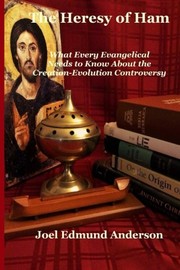
The Heresy of Ham
What Every Evangelical Needs to Know about Young Earth Creationism, the Creation-Evolution Controversy... and What We Can Learn about Rigid Ideology and "Fighting the Culture War"
Finished 12/8/25
4/5
"I really liked it"
In a sea of awful Christian blogspam, I recently stumbled across Joel Edmund Anderson’s blog and found a jewel. His writing is pretty good, and so are his takes. When I saw that he wrote a book about Ken Ham… well, let’s just say I ordered the book within a few days.
On the whole, I was pretty happy with The Heresy of Ham. The title makes a bold claim: Ken Ham, the (in)famous young earth creationist who debated Bill Nye in 2014 over creationism, founder of AnswersInGenesis (AiG), the Creation Museum, and the Ark Encounter, is a heretic? I’m certainly not a fan of Ken Ham, but I approached Anderson’s claim with caution; calling a Christian whom you disagree with a heretic is a tactic I often see from fundamentalist Christians, and I’m wary of its overuse.
In the book, Anderson defines and explores the concept of young Earth creationism (YECism), which is basically what you get when you insist that Genesis must be read fully literally. I’ve long known that Ham’s entire ministry is perpetuating this view, but I somehow missed his bigger agenda: Ken Ham isn’t just a speaker, he’s a self-proclaimed warrior. According to Ken Ham’s worldview, American is going downhill due to a rejection of Christian morals. Evolution is being taught in our schools as the anti-God religion, and Ham says the only path forward is to convince powerful Americans that the Bible is true, and we should be Christian again. If you thought, wow, that’s a lot to take in, so did I, but it doesn’t stop there.
If you disagree with Ken Ham, he sees you as a representative of the enemy, and you are basically not even a Christian. Ham’s extreme views are slowly propagating across America, and he’s gaining the influence he seeks. At the same time, non-YECist Christians like Anderson are getting pushed out in the name of the “culture war”.
Anderson’s titular “heresy of Ham” is that Ken Ham insists that a literal reading of Genesis is necessary to the Christian faith; Anderson goes further by claiming that YECism is unscientific, and unsupported by both the Bible and the history of the church. While I think Anderson does a commendable job defining “heresy” and proving that Ham is guilty of it, he falls somewhat short of proving that YECism is “not biblical” and “not part of the historical church”. The truth is that many historical Christians saw history in Genesis, even if they layered their interpretations with allegory and theology; and certainly, the New Testament at least suggests that a historical Adam existed.
But for Ken Ham and his legion, these facts don’t matter. Ken Ham’s base assumption is that Genesis is literal history, and I’m convinced that no amount of scientific or biblical evidence will convince him otherwise. To fit the mold of a literal Genesis interpretation, AiG is willing to bend any shred of scientific evidence over backwards until it breaks.
As human beings, we all yearn for purpose and meaning. Yet the fact is, purpose and meaning can only be attained by someone who does the hard work of trying to examine life in all its complexity. It requires contemplation, reflection, humility, and determination. It doesn’t come easy… far too many people don’t do the hard work of searching for truth. It’s too hard, too time-consuming, and sometimes uncomfortable— after all, when we search for truth, we will inevitable have to confront things about ourselves that we’d like to pretend aren’t there, and sometimes we have to admit we are wrong… how does one attain a sense of purpose, truth, and meaning if one is either too lazy, too busy, or too fearful to search for it? The answer to that question… [is] idolatry.
— Joel Edmund Anderson
Ultimately, I think Anderson makes a correct claim that many Protestants have idolized the Bible. Finding truth is difficult; why not just assume a literal interpretation of the Bible is correct, and ignore everything else? This is AiG’s modus operandi; born out of the Enlightenment’s insistence on cold, hard truth, they refuse to seek any further nuance in Scripture.
Besides some typos and small historical mistakes,1 The Heresy of Ham largely delivers on its titular claim, and does a fantastic job exploring the details of YECism and Ken Ham. If you’re interested, I encourage you to read my summary of the book below. I spent many hours summarizing and organizing Anderson’s thoughts, along with some of my own original research and thoughts. I hope you enjoy.
What is Young Earth Creationism?
If you read the Old Testament literalistically, as a literal, scientific account of historical events, you will conclude a few things. For example, you’ll conclude that the human race was started by 2 people named “Adam” and “Eve” who were sinless before the fall; you’ll conclude, using the genealogies, that the Earth is ~6,000 years old; you’ll conclude that a worldwide flood occurred a few thousand years ago, which Noah and his family survived by building a large Ark.
Reading Genesis this way is called Young Earth Creationism (YEC), because the Earth is “young”. There are various other methods of interpreting Genesis, like the “Day-Age” theory, or that the Earth is old (“Old Earth Creationism”), or that it’s all just a metaphor. The views of the YEC community stick out because they are a very vocal minority. Their spokesperson? Ken Ham, the founder of Answers In Genesis (AiG). Ken Ham is famous for AiG and his debate with Bill Nye in 2014. AiG is popular for building the Creation Museum and Ark Encounter, two Christian attractions in Kentucky. AiG describes itself as an “apologetics ministry” that focuses on “providing answers to questions surrounding the book of Genesis”.2 Ken Ham and AiG spent most of their time defending their literal reading of Genesis, and disparaging anyone (Christian or otherwise) who disagrees.
Is YECism Scientifically Accurate?
The Heresy of Ham allocates only a small section to the scientific evidence against YECism. I’ve summarized the major points below, and also an AiG response to each one. This is not an exhaustive list, i.e. there is plenty of anti-YEC scientific evidence that I haven’t included here. Also, the AiG responses should be considered strawman arguments, because I’m not interested (in this specific post you are reading) in enumerating all the various argument and counterarguments to the scientific claims. So, this list should be considered highly biased, but the evidence mostly speaks for itself.
- Tree rings: trees grow a new ring every year, and we have trees with 9,500 rings.
- AiG answer: before the flood, trees could have grown additional rings per year (no evidence); or, God created the trees with rings in place.
- Ice cores: we can drill ice cores in Antarctica and see snow layers, which accumulate at specific rates and get compressed over time.
- AiG answer: Ice can accumulate faster than scientists think, so the abundance of layers doesn’t necessarily mean an old earth.
- The fossil record: humans are much closer to the surface (as far as underground layers of fossils), and we see a clearly delineated history (e.g. humans on top, dinosaurs on the bottom). We don’t see any mixing of fossils, e.g. we don’t see humans and dinosaurs in the same layer. The layers also date millions of years apart.
- AiG answer: humans floated during Noah’s Flood, so their fossils would be on top, but they were also probably eaten. The other humans didn’t live close to dinosaurs (too dangerous), so their fossils wouldn’t be in the same layer.
- Starlight: we see light from stars billions of years away, which suggests the universe is very old (so the light could travel from the star to us)
- AiG answer: it’s a miracle, or the speed of light is actually variable, or there are time zones in space, or God created the light in place
- Abundance of species: even if Noah kept ~7,000 “kinds” of animals on the ark, we have ~16 million species now, so that’s an average of 11 new species per day since the flood. If you only count land animals, it’s still a new species every 8 years.
- AiG answer: the animals rapidly speciated after the Flood, faster than normal.
- DNA evidence of evolution: apes have 24 pairs of chromosomes, but humans have 23. However, there is clear evidence that our “missing pair” actually combined with another pair, so we probably share a common ancestor.
- AiG answer: rejects evidence of chromosomal fusion, saying it didn’t happen
- Argument from silence: for example, we have no evidence for a global flood
Using this evidence, Anderson concludes that YECism is “unscientific”. Ken Ham, on the other hand, is convinced that “the scientific evidence confirms the Bible’s account.” I am fully convinced that no amount of scientific evidence will persuade Ken Ham (and many YECists) that he is wrong.
Is YECism the Historical Church Position?
At this point, a discussion of the church fathers is warranted. I just read Craig D. Allert’s book, Early Christian Readings of Genesis One, so I’m particularly empowered to write about this. Essentially, there is a group of early Christians that had a significant influence on the early church community and orthodoxy. In most discussions, “early” goes till the time of Augustine (~400 CE). Luckily, we still have the writings of many of these church fathers and their thoughts about certain Christian topics.
In the book, Anderson makes a big effort to establish the credibility and importance of these early church fathers. He admits they weren’t “infallible”, but our modern-day Christian doctrines can largely be traced back to their writings and influence. I think Anderson is mostly correct here, yet most Protestants are “willfully ignorant” (Allert) of these church fathers. For example, the doctrine of the Trinity is considered a basic, essential doctrine of Protestantism, but the Trinity is not biblical. This doctrine was created by the church fathers to explain certain biblical texts. In this way, Protestantism owes a lot more to “tradition” than it prefers to admit.
In Allert’s book, he criticizes modern Christians for using the early church fathers as simple “ammunition” in the creation/evolution debate. Ken Ham certainly does so, claiming that YECism is the historical position of the church; I was afraid that Anderson would also fall victim to this technique, but he showed commendable nuance. At a minimum, the early church fathers never used YEC terminology, as the concept didn’t exist at their time:
[the early Church Fathers] couldn’t have been young earth creationists, any more than they could have been Socialists, Capitalists, Democrats, or Republicans. For YEC is a thoroughly modern movement that has come about as a reaction to the modern theory of evolution.
— Joel Edmund Anderson
We don’t see extended discussion of the historicity of Genesis in the creedal statements, so that’s a sign that it wasn’t an issue of extreme importance. However, several church fathers discuss the historicity of Genesis. For example:
- Philo of Alexandria (25 BCE—50 CE) encountered contradictions in Genesis and concluded they were signs that it should not be read literally.
- Origen (185—253) famously interpreted Genesis highly allegorically, calling it “foolish” to interpret completely literally.
- Augustine is used by Anderson as evidence of allegorical interpretation, but this is only half true. Augustine wrote about Genesis a lot, and his views aren’t always 100% clear. In The Literal Interpretation of Genesis, Augustine argues that it’s dangerous when Christians argue against experts of reason and make Christianity look stupid, but he also looks for highly literalistic meanings of every word of Genesis. But, Augustine also allegorizes much of Genesis. It’s just not simple to classify him as “allegorist” or “literalist”, but he certainly saw history in Genesis.
- Martin Luther: thought the Earth was 6,000 years old, even calling Augustine too allegorical; however, Luther’s main point was that the world has a beginning, not its exact age.
- John Calvin: interpreted Genesis pretty literally, but also believed in divine accommodation: a common historical view that Moses “dumbed it down” for us readers, and didn’t try to include exact scientific information
- John Calvin also believed that pro-heliocentrists were possessed by the devil, so he was clearly not a fan of science trumping the Bible.
To recap: no church father was a YECist, because YECism didn’t exist in those early days. It’s fair to say that Genesis has always had varying interpretations, both literal and allegorical (and often both). Even after evolution became widely accepted, many Christians did not see it as a threat. Anderson points out that Darwin never postulated evolution to be against theism; Darwin was an atheist, but because his daughter died at 10, not because of evolution.
The Roots of YECism
Although some historical Christians confessed similar beliefs to YECism, the modern YEC movement really started in 1923, when Seventh-Day Adventist George McCready-Price published The New Geology. McCready-Price was influenced by Seventh-Day Adventist founder and “prophet” Ellen G. White, who supposedly saw visions of creation and Noah’s Flood. The Scopes Monkey Trial brought “Bible vs. evolution” ideas to the mainstream, and this was further solidified by another pro-YEC book in 1961 titled The Genesis Flood. The authors of The Genesis Flood went on to start now-popular pro-YEC ministries like Creation Research Society and the Institute for Creation Research.
The Genesis Flood is, in many ways, a forerunner to Ken Ham’s ideology. Both push the idea of a culture war, where evolution and atheism are facing off against God’s word and the Bible; both also believe that the best way to fix our morally degrading society is to re-implement creationism in education, so we can indoctrinate the youth and put YEC leaders back into power. This is Ken Ham’s main agenda.
Is YECism Biblical?
What does the Bible say about young earth creationism? Obviously, the entire idea of YECism is based on a specific interpretation of Genesis, but now is when we ask: how should Genesis be best interpreted? Ultimately, there is no consensus. The YEC movement is a great example: Ken Ham is convinced that you should read Genesis literally, and nothing can convince him otherwise. But, when you consider how the Bible has been interpreted in the past, his view is a minority.
The Problem of Interpretation
To be a Christian, in my opinion, requires you to confess the doctrine of inspiration. The principle here is that the Bible is from God (in some way), or that God had a part to play in the authorship of the Bible (alongside the human authors). The important question is basically: what are God and the original author trying to communicate through the Bible?
To answer this question, we have to interpret the Bible’s words. The tricky thing, of course, is that interpretation always includes bias. We like to pretend we are objective judges, but as Anderson says, “one cannot fall into the trap of thinking, ‘It’s just me, Jesus, and the Bible!’” Like it or not, we are unduly influenced by our culture and upbringing.
Luckily, since people in biblical times also interpreted older Scripture, we have examples of interpretation within Scripture itself. Consider Jesus and Paul: both interpret certain passages of the Old Testament, but add entirely new layers of meaning on top. In The Heresy of Ham, Anderson argues that we shouldn’t read our bias back into the text. But, that’s exactly what Jesus and Paul did! I wrote about this in my review of Craig Allert’s Early Christian Readings of Genesis One:
Supporters of the grammatical-historical method often claim that it has a basis in Scripture, e.g. when Jesus quotes the Old Testament he will often say “Have you not read?” as if his newly introduced interpretation was clear from the outset. Allert easily deconstructs this argument, showing that the entire point of Jesus’s remark was that the Pharisees only looked at original context and did not understand a deeper, often more allegorical, meaning. Additionally, in Galations 4:21-26, Paul explicitly interprets a passage in Genesis as allegory, literally saying “Now, this is an allegory”. Paul ignores the original intent and avoids a “plain reading”. Again in 1 Corinthians 10:1-11, Paul points to Old Testament events (which are clearly written as historical events) and explicitly says “[these things] were written down to instruct us”. This is a much deeper and much more nuanced reading than just “the most straightforward”!
This kind of extreme re-interpretation of Scripture is problematic for Anderson; certainly we’ll allow Jesus to re-interpret as he wishes, but if Paul can ignore original context and insert his own bias into the Old Testament, why can’t we do that too? Anderson doesn’t really address this difficulty. The simplest solution, and perhaps the one I would take if hard-pressed, is that Paul (and other biblical authors) gets an excuse for his “problematic” interpretive methods because he was being inspired by the Holy Spirit to author his writings. But, this is not a very satisfying answer. I digress…
Sticking with Anderson’s rules, Biblical readers should try to minimize bias and think from the perspective of the original audience. We don’t know exactly when Genesis was written (probably either during antiquity, or during the Babylonian exile), but Anderson says we can safely assume they would not read it as a literal, scientific, historical account. Genesis 1-11 is clearly in the genre of myth— in this usage, “myth” doesn’t mean “untrue/fairy tale”, but more like “it regards the ultimate meaning of human beings, creation, and the god(s)”.
We can also infer how the Israelites would read Genesis based on what we know of other creation stories in the ancient near-East (ANE). For example, the ancient Greeks did not consider their myths of Zeus and Kronos to be completely literal history.3 We also know that Genesis, unlike other ANE myths, says (among other things) that creation is good, that humanity was created in God’s image, and that there is only one God. It’s likely that the author of Genesis is playing on other familiar myths in the region, but changing the stories to reflect theological truths about the God of Israel.
According to Anderson (and I mostly agree), it’s mostly the influence of the Enlightenment that forces us to think “truth = historical fact”. For most of human history, truth was a lot more flexible than that, and the ancient Israelites would not be sitting down doing the math of how many years the Earth has been around based on the genealogies. They’d be much more interested in the theological implications. It makes very little sense to imagine the original audience of Genesis caring anything about the scientific and literal nature of the text.
Evidence Within the Bible
There are several signs within Genesis itself that point to a non-literal interpretation being the best one. For example, we see God literally walking in a garden on Earth (which many later theologians took issue with), a talking snake that presumably walked on legs before being banished to slither, and Adam’s name that literally means “humanity” in Hebrew. Contrary to the popular notion of creation ex niliho, the Earth and a “watery deep” exist before God does any creation. The place-names used in Genesis 1—11, like the land of “Nod”, do not refer to any actual location on Earth (at least as far as we know). Finally, there are at least two obvious contradictions between the two creation accounts in Genesis 1 and Genesis 2: Genesis 1 says plants before mankind and creation over 6/7 days; Genesis 2 says mankind before plants, and only 1 day of creation.
However, if we interpret Genesis to be entirely fictional, such that e.g. Adam and Noah never existed as literal human beings, then how do we understand the references to Adam and Noah from the New Testament, like the sayings of Jesus and the writings of Paul?
Anderson maintains that “There is nothing in the New Testament that demands we read Genesis 1—11 as literal history.” He is technically correct, but there are certainly passages that suggest we should read Genesis literally; I would even say the most straightforward reading is that e.g. Paul believed that Adam really existed. Take, for instance, 1 Corinthians 15:22: “For just as in Adam all die, so also in Christ all will be made alive.” Then, verse 47, “The first man is from the earth, made of dust; the second man is from heaven.” There are other passages, like Romans 5, but I think these passages at least suggest that Adam was historical, or at least that Paul thought so. Pete Enns puts it plainly:
Evangelicals will never make peace with evolution until they can accept that St. Paul believed in a historical Adam— but he was wrong.
— Pete Enns
Another New Testament issue for denying a historical Adam is the genealogies of Jesus presented in Matthew and Luke, which trace back to Abraham and Adam, respectively. Basically, it is very difficult to harmonize these two genealogies and insist they are both literally true; they even trace back to two different sons of David. There are some clever ideas that Christians have used to make sense of it, but the far easier explanation is that they, too, are allegorical in purpose! More specifically, they are theological in purpose (e.g. to establish that Jesus, like anyone else, is a son of Adam, or in the line of David, etc.)
Similar to references of Adam, the references to Noah and the flood do not “demand” a literal reading of Genesis, but can suggest it. Anderson, and myself, hold that these characters could have literally existed, and the New Testament authors may have thought they existed, but neither is necessary to get the theological points across.
The Primary Doctrines
What makes someone a Christian? Ask around, and you’ll get 1,000 different answers: “anyone hwo confesses faith in Jesus Christ as their lord and savior”, or “they also must believe in the Trinity”, or “anyone who believes Jesus was a nice guy”, or just “anyone who claims to be”. There is no copyright on the word “Christian”, so anyone can claim the title, but every Christian draws the line somewhere. The question is, where should the line be drawn? Even if you look to the Bible, there are many answers.
Over the generations, various Christian groups have used certain “litmus tests” to determine if someone is a “True Christian”. In the 2000s, this practice has exploded, and evangelicals have come up with plenty of creative litmus tests. A recent one is inerrancy: if you don’t believe in verbal plenary inspiration and sign the CSBI, then to many evangelicals, your salvation is practically in danger. In the book, Anderson brings up an interesting past example: for a brief period in the 300s, a group of Christians called Arians believed that Jesus was somewhat submissive to God the Father and basically “less God” than him. These Arians were a minority, but briefly held power in the orthodox church, came up with their own creed that included Arianism, and punished those that disagreed with them. Arianism was eventually declared a heresy, the Arians lost power, and the Church moved on.
When someone draws the line between “Christian” and “non-Christian”, it’s typically drawn to encircle a specific set of beliefs: if you hold all of these beliefs, you’re Christian; otherwise, you’re out. The specific beliefs in that circle are called the primary doctrines (or primary beliefs), and any other belief is secondary (or tertiary, and so on).
The Nicene Creed
So, what makes a doctrine primary or secondary? In The Heresy of Ham, Anderson makes the point that the church fathers also considered this, and gave us a clear tool: the Nicene Creed, which was formulated in 325 CE, shortly after the resolution of the Arian controversy. The Nicene Creed includes things like:
- There is one God; this includes the Father, Son, and Holy Spirit
- Jesus is the eternal son of God, was crucified, buried, resurrected, and ascended to heaven
- Jesus will return for judgement day
Almost every Christian denomination submits to the Nicene Creed, except for the most extreme Christian spinoffs like Jehovah’s Witnessess and the Latter-Day Saints (Mormonism). This includes at least 98.7% of global Christians.4 Shortly after the Nicene Creed was drafted and accepted, it was frequently called a symbolum (Greek), which means something like “symbol”, “mark”, or even “token of recognition”. Later church fathers like Augustine refer to the Nicene Creed as a symbolum. Thus, Anderson’s point that the Nicene Creed should be the “litmus test” of Christianity has an actual historical basis.
For Anderson, the Nicene Creed is the only valid “litmus test” we should use to determine if someone is a “Christian”. He does not say this outright, but I think Anderson would also say that the matters discussed in the Creed are the only doctrines that are salvific in nature. For example, if you do not believe that Jesus Christ was a real person, Anderson would probably say you are not a Christian, and you are not “saved”. This would only be a problem for those ~1.3% of Christians who fall outside the creed (e.g. Mormons).5
What Makes a Heresy?
The title makes it clear: Anderson is calling Ken Ham a heretic. But, what even makes a heresy? In the book, Anderson offers a few definitions:
- A belief that contradicts a statement in the Nicene Creed (e.g. “Jesus is not God”)
- A belief that a specific doctrine outside the Nicene Creed is primary, salvific, or fundamental to Christianity (e.g. “If you don’t pray twice a day, you’re not a Christian”)
- A belief unsupported by evidence or the historical church
Ken Ham indisputably violates definition #2 by claiming that YECism is a primary issue. It’s somewhat difficult to pin down Ham’s exact position on the importance of YECism, but we have some pretty vicious statements, like:
- “To believe in millions of years is a Gospel issue.”
- “It is a salvation issue in an indirect sense.”
- “Once you give up a literal Adam and Eve— and thus reject a literal Fall— then you may as well throw the Bible away.”
- “[to not believe YECism] ultimately impugns the character of the Creator and Savior and undermines the foundation of the soul-saving Gospel.”
- “I believe organizations like BioLogos, even if staffed by Christians, are helping the devil in leading [indoctrination of young children in false teaching] and coming generations away from the truth of God’s Word.” (For context, BioLogos is a pro-evolution, pro-science Christian ministry)
It’s fair to say that Ken Ham thinks YECism is a foundational and primary doctrine, and essential to the Christian faith; if you disagree with him, you are “helping the devil”, “impugn[ing] the character of the Creator and Savior”, and “undermin[ing] the foundation of the soul-saving Gospel.” These statements make it hard for me to believe Ken Ham when, in another place, he says “Salvation is conditioned upon faith in Christ, not what a person believes about millions of years and evolution.”
…what I am calling the “heresy of Ham” is the taking what has always been a secondary issue within the Church and claiming it is now the foundational cornerstone to the entire Christian faith.
— Joel Edmund Anderson
Anderson makes it clear that merely believing in YECism, or that the Earth is young, or that evolution is false, is not heresy. The heresy is the explicit promotion of YECism to “primary doctrine” status. In my opinion, the evidence is more than sufficient to label Ken Ham a heretic (if we are going with Anderson’s definition).
Why Does it Matter?
So, Ken Ham is probably a heretic because he places far too much importance on YECism, which was never supposed to be a primary issue. Anderson has spent the entire book explaining what YECism is, and why it’s not supported by good evidence. So what? Can’t we just agree to disagree with YECists, and move on?
You see, that’s exactly the problem: we can’t just move on. Ken Ham and his army of YECists in AiG and other “creation science” ministries are emphatic that our society is in a “culture war”: on one side are the pro-evolution, immoral atheists, and on the other side are the moral YECist “True Christians”. If you’re not a YECist, Ham calls you a “compromised Christian” who is “helping the devil”. Ham’s battle plan is to indoctrinate the youth into YECism, so they can get into powerful positions and reshape the USA to become more Christian (and thus, more moral).
An all-out attack on evolutionary thinking is possibly the only real hope our nations have of rescuing themselves from an inevitable social and moral catastrophe.
— Ken Ham

Ken Ham isn’t alone: 69% of people people who regularly attend church weekly believe that God created human beings in their present form at one time in the last ~10,000 years. 64% of white Evangelical Protestants reject that idea that humans evolved at all. And as Anderson rightly points out, “I doubt those poll numbers are the result of people having actually investigated the issue.” Thanks to Ken Ham’s “culture war” battalions, YECism is now a popular view in Christian culture, and some Christians are starting to execute Ken Ham’s vision by kicking out non-YECist Christians.
When YECists get in positions of power, heads start to roll.
— Joel Edmund Anderson
This whole saga reminds me so much of the literature I’ve read about biblical inerrancy: YECism is being used like a “litmus test”, and if you don’t pass, you’re out. Anderson, for example, was fired by his Christian school principle because Anderson wouldn’t agree to YECism. Describing his experience, he criticizes his principle of not being “interested in honestly discussing the complexities of the scientific issue”. For these YECists, “since I had a different view… than them, that was justification enough to label me and dismiss me as dangerous.”
Ken Ham’s crusade against evolution affects how the public views Christianity, and how Christians view their own community. As young Christians seek answers about evolution, their YECist peers are drawing lines to exclude them. The same effect is happening at American religious institutions, like Christian colleges. But the truth is, YECism isn’t worth dividing over. It’s never been a primary doctrine. It has almost zero scientific basis. The faster American evangelicals can accept that, the faster we can all finally move on.
Footnotes
-
The most notable historical mistake is when Anderson claims that “the Council of Nicea also clarified what the canon of the New Testament was.” That’s not true. Wikipedia says “There is no record of any discussion of the biblical canon at the council.” The Gospel Coalition says “There is no historical basis for the idea that Nicaea established the canon and created the Bible.” Apparently Richard Dawkins also makes this incorrect claim in his book Outgrowing God. But, Anderson only mentions this “fact” as a passing reference; it’s not a basis for any argument. ↩
-
In terms of whether the Greeks believed their own myths, there isn’t a lot of data to work with. It seems that people saw a historical kernel of truth in these myths, but weren’t fully on board. Some mixture of history and myth. ↩
-
https://www.pewresearch.org/religion/2011/12/19/global-christianity-exec/ ↩
-
Just to be clear, I’m not claiming that Mormons claim that Jesus wasn’t a real person. The claim is just an example of something in the creed, and Mormons are just an example of non-creedal Christians. ↩