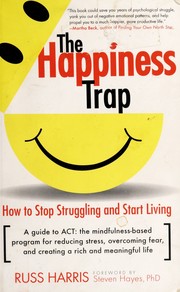
I picked up The Happiness Trap in an effort to educate myself on one of the most popular and effective therapy techniques: Acceptance and Commitment Therapy (ACT). ACT is technically part of Cognitive Behavioral Therapy (CBT), but there are some important differences— I’ll cover those and more in an upcoming blog post about ACT.
In any case, Russ Harris has published several books on applying ACT, mostly writing for the ACT therapists themselves. The Happiness Trap is his “pop” version, where he tries to explain ACT by replacing the technical jargon with anecdotes, analogies, and a bit of humor. In hindsight, I should have bought his more technical ACT primer called ACT Made Simple, but alas. Despite the “dumbed down” language, I learned a lot from the book, and I’d consider Harris to be a good writer. For starters, it’s always a huge plus when self-help authors (and I hate calling Harris, a pro-ACT doctor, that) recognize the limitations of their own methodology: Harris knows his exercises and techniques won’t help everyone or every situation, and he freely admits his own shortcomings. But, he’s adamant that ACT is an incredibly helpful theory; he quotes “over 3000 published studies that show [ACT’s] effectiveness”. I was not able to verify that specific claim, but there are certainly hundreds, if not thousands, of ACT studies that attest to its effectiveness. ACT is the real deal.
As mentioned above, I’ll be diving headfirst into ACT soon, but here’s the 3 broad ideas:
- Be present. Focus your attention on what’s important and engage in what you do.
- Open up. Unhook from your thoughts; allow them to be as they are and let them freely flow through you.
- Do what matters. Act effectively, guided by your values.
Harris was able to explain the basics in a way that was (mostly) intuitive for me, but there was plenty of fluff along the way. At a minimum, this book alone was enough for me to feel ready to use ACT in my own life and to help others. Perhaps I’ll pick up the more technical ACT Made Simple in the future.