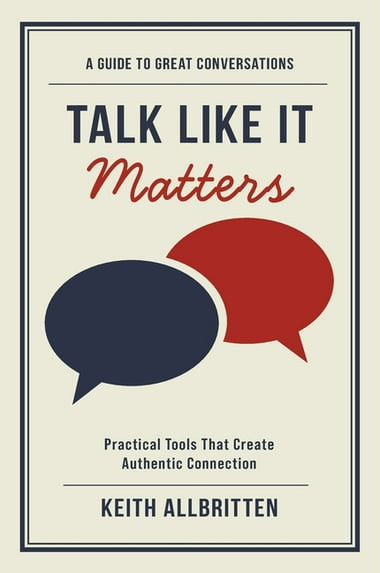
Talk Like It Matters
Practical Tools That Create Authentic Connection
Finished 1/1/26
4/5
"I really liked it"
My dad wrote a book! Just a few weeks ago, Keith Allbritten released Talk Like It Matters. As someone who reads the occasional self-help/communication book, of course I picked it up!
My dad is really good at talking to people— and at teaching people how to talk to people. He knows this, and as a leadership coach, it’s basically his entire job. His book is basically a battle-tested “bag of tricks” to help anyone connect with other people in better ways. Several pieces of advice I read in Talk Like It Matters reminded me of things from either Dale Carnegie’s How to Win Friends and Influence People or Marshall Rosenberg’s Nonviolent Communication. Most books in the “self-help” genre are basically just entertainment, but I think these communication-oriented books offer real, practical advice. Keith’s new book fits nicely into that useful bunch.
The core ideas of the book center around listening well. As Keith puts it, “Great conversationalists are great listeners.” In a good conversation, you should be listening most of the time— with no distractions, no multitasking, no agenda, and no judgement. People love to talk about themselves. Use verbal and nonverbal cues to show that you care, that you’re interested.
If you aren’t curious about other people, this book isn’t going to help you very much. Being authentic is an important piece of the puzzle; you can’t fake it. I suspect this is where many people fail in conversations: truly, they just aren’t interested, and it’s very obvious. Of course, not every conversation is going to be interesting, but if you want to have good conversations, find a way to be genuinely interested in the other person and what they’re saying.
In all these things, be genuine. If you use these tools to manipulate, it’ll be obvious. Being inauthentic is worse than showing no interest at all.
— Keith Allbritten
I appreciated Keith’s humility in the introduction that not every tip and trick will work for every scenario. But, it’s likely that many will help. This book isn’t some cure-all for everyone’s problems. It’s just some ideas and strategies for making the most of your conversations.
Summary
As a good listener, you should:
- Be willing to share your precious time.
- Be genuinely interested about the other person, and what they’re saying.
- If you’re unhappy with a conversation, feel free to use verbal and/or nonverbal language to communicate that. Don’t fake interest!
- Spend 80% of the conversation listening, and only 20% talking.
-
If your objective is to have a great conversation, don’t plan to talk about yourself much.
- In my opinion, this is only useful as a guide for some conversations, especially with people you don’t know as well. Close friends and family will hopefully involve more equity, but it’s highly variable.
-
- When you’re listening…
- Be fully attentive: no distractions, no multitasking.
- Use eye contact and nonverbal cues to communicate that you’re interested and engaged.
- Pick your battles: don’t interrupt or correct someone unless it really matters.
- Resist the urge to fill silence, or finish their sentence.
- Reflect what people say back to them, then ask if you’ve got it right.
- Ask open-ended questions.
- Ask deep questions (values, beliefs, experiences).
- When you’re talking…
- Be willing to be vulnerable: point out something the other person doesn’t know about themselves, or reveal something unknown.
- Refrain from offering advice unless it’s abundantly clear they want it.
- Don’t try to one-up people’s stories.