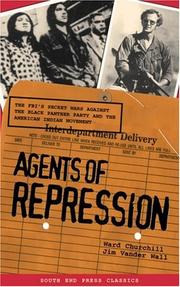
Agents of Repression
The FBI's Secret War Against the Black Panther Party and the American Indian Movement
Finished 2/10/26
4/5
"I really liked it"
No society professing to be, or even aspiring to be, free, open, and committed to democratic ideals can afford to allow its police agencies anything approaching this degree of cynicism and duplicity, or such latitude in operational discretion.
— Ward Churchill & Jim Vander Wall
The experience of reading this book was a pessimistic rollercoaster of anger, sadness, fear, and hopelessness. Ward Churchill and Jim Vander Wall completely followed through on the book’s subtitle: the FBI, and the US government more broadly, has engaged in heinous actions against several movements and organizations. One of my main takeaways from the book is this: if you (a U.S. citizen) organize against the interests of the U.S. political majority, you will experience pushback— frequently in illegal form.
[if you challenge the U.S. status quo] You and your organization are thus a matter of concern to the FBI and, therefore, subject to one or another level of intelligence and counterintelligence attention… You are a “deviant” who has thereby become a real or potential threat to one or another tenet of the status quo.
— Ward Churchill & Jim Vander Wall
Most of the book is dedicated to the FBI COINTELPROs (“Counter Intelligence Programs”), such as those directed against the Black Panther Party (BPP) and the American Indian Movement (AIM). Other targeted organizations were associated with communism, anarchism, anti-war efforts, or other anti-elite interests. The pretext was that these organizations presented a threat to America in some way— mostly accusations of violence, sedition, etc. The goal of COINTELPROs was to generally destroy and discredit the targeted group via several effective methods, like turning members into FBI informants (commonly accomplished with threats), encouraging members to do violence, faking divisive communications or accusations between members, mailing fake letters, etc. The book covers several morally corrupt instances of COINTELPRO action, but as one such example, the FBI illegally spied on MLK Jr., recorded tapes of him engaging with a prostitute, and sent some of those recordings to MLK Jr. along with an anonymous letter encouraging him to kill himself. COINTELPRO was very effective: with basically no legal guardrails in their way, the FBI was able to successfully destroy the BPP, AIM, and many other anti-majority organizations. Even the FBI recognizes the wrongdoing involved in COINTELPRO, even if their statement takes little accountability:
COINTELPRO was later rightfully criticized by Congress and the American people for abridging first amendment rights and for other reasons.
Ward Churchill
Churchill (one of the book’s two authors) has a controversial history, including false claims of American Indian heritage, calling 9/11 victims “little Eichmanns” (referring to a Nazi), and an academic misconduct case in 2007 that left him fired (though the verdict was later overturned in his favor by two higher courts). From what I’ve read, I don’t believe that Churchill is generally a bad faith actor; rather, Churchill seems to have an axe to grind against the FBI and government, and probably feels personally wronged by the (legitimate) injustices performed against American Indians, regardless of his own American Indian heritage. Some of his conclusions are biased, and he tends to overly trust some theories, rather than engaging in totally objective truth-seeking. But, the same charge can be made of most of us. It is unfortunate, though, that the book is slightly tainted with this bias; in the end, there is plenty of legitimate material to back up Churchill’s conclusions that, for this book’s purposes, his storied past shouldn’t worry us.
The Black Panther Party (BPP)
…the Black Panther Party, without question, represents the greatest threat to internal security of the country.
— President Hoover, 1969
The FBI, as part of a COINTELPRO, hired trusted BPP member William O’Neal as an inside informant, by offering to drop some felony charges. O’Neal was an “agent provocateur” who encouraged violence, offered gun training, and created a BPP process for torturing and killing FBI informants. O’Neal’s actions helped paint the BPP as a violent organization and provided the pretext for continued government action against the BPP. This style of infiltration is favored by the FBI and was also used against the AIM.
Much more can be said about the FBI’s interactions with the BPP, and the book explains much of it. The gruesome 1969 BPP raid conducted by the Chicago Police (in partnership with the FBI) is worth highlighting. Some high-ranking BPP members were drugged by an FBI informant (probably O’Neal, but he denied it) hours before the raid. Upon arrival, the police were responsible for the vast majority of the shooting: the only shot from BPP members was a single death-reflex shot. The policemen were overheard shooting a wounded member to ensure he was “good and dead” after discovering he survived initial shots. The police killed 2 members, then wounded, beat, and arrested 4 others.
Afterwards, fake evidence was given to the press to create a narrative that the police were ambushed and attacked. The Chicago police claimed the Panthers shot first. The local county state’s attorney said “The immediate, violent, criminal reaction of the occupants in shooting at announced police officers emphasizes the extreme viciousness of the Black Panther Party.” The cops were commended for showing “remarkable constraint”. It took a while for the public to find out what really happened. The FBI made a deal with the cops to not expose each others’ wrongdoing. In 1982, after years of deliberate stalling and judicial wrongdoing, the government agreed to a settlement and gave the families of the victims some money. Nobody went to jail. O’Neal, the FBI informant, committed suicide in 1990.
The American Indian Movement (AIM)
The history of the American Indians versus the U.S. is a sad story whose ending we should all be familiar with. Time and time again, the “guaranteed” rights of American Indians was ecstatically trampled on by European settlers.
The Indian must conform to the white man’s ways, peaceably if they will, forcibly if they must. This civilization may not be the best possible, but it is the best the Indians can get. They cannot escape and must either conform or be crushed by it.
— Commissioner of the Bureau of Indian Affairs, 1889
Part of this history involves the Lakota people, whose land was continually invaded in violation of government treaties. This time, it was for “rich minerals”. In the 1880s, common American Indian rituals were outlawed, and their children were shipped to foreign schools and banned from speaking their native language. In the 1890s, a sort of spiritual uprising (the Ghost Dance) was gaining popularity among American Indian populations, and the government, fearing an armed attack, preemptively struck: they went to arrest Sitting Bull, and when one of his followers shot at them, they responded by murdering Sitting Bull. They then chased and captured Sitting Bull’s group of ~350. The group surrendered, and during their disarmament, a deaf Lakota fought back, probably the result of a misunderstanding. A few other Lakota people might have joined him. The government responded in the Wounded Knee Massacre with indiscriminate killing, pursuing some Lakota for miles on horseback to kill them. Hundreds of Lakota were killed.
They [the Indians] are a conquered nation, and when you are conquered, the people you are conquered by dictate your future. This is a basic philosophy of mine. If I’m part of a conquered nation, I’ve got to yield to authority… [the FBI must function as] a colonial police force.
— Norman Zigrossi, ASAC of the Bureau of Indian Affairs Rapid City office, 1976
Fast-forward to the 1970s, and U.S. attitudes towards the inconvenient natives had hardly changed. American Indians across the nation began to form a united and energetic front. The American Indian Movement (AIM) was founded in 1968 during this movement. In 1973, in the middle of legal disputes with the government, the Wounded Knee Occupation happens. The standard COINTELPRO treatment is given to the movement, including legal stonewalling, delaying journalists and reporters, fabricated evidence provided to the press, broken promises, etc.
Ward Churchill and Jim Vander Wall go on to demonstrate the various FBI tactics against AIM, going into excruciating detail that was painful to read. One such tactic is indirect assassination, whereby the FBI purposefully encourages and allows infighting amongst an organization, including murder. There are several examples, but I’ll highlight the case of Anna Mae Aquash. In short:
- FBI hires Douglass Durham to be an FBI informant and agent provocateur inside the AIM. Durham significantly shaped the negative public opinion of AIM.
- An FBI agent known as David Price interrogates AIM member Anna Mae Aquash. According to the FBI, during the interview, Aquash lays her head on the table and says “Either lock me up or shoot me. That’s what you’re going to do anyway, and that’s the two choices I’m taking.” According to Aquash, Agent Price responded by saying she’s right, and she wouldn’t “live out the year” unless she cooperated. Aquash chose not to cooperate.
- Douglass Durham and another agent provocateur spread rumors that AIM member Anna Mae Aquash is an FBI informant (this is an FBI tactic called “bad-jacketing”).
- High-ranking AIM members, possibly including Leonard Peltier, are convinced by the rumors and murder Anna Mae Aquash in 1976.
- The FBI (including Agent Price) pretends not to recognize her body, then pretends not to notice the bullet hole in her head during an autopsy, then fails to prosecute the killers for decades.
- Shortly after her death, the FBI receives a tip confirming the killers and cause of death, but ignore this and publicly deny involvement or the existence of any leads.
- In 1975, Douglass Durham is paid by the FBI to testify before Congress that the AIM is a violent organization, and has “the ability to create great havoc and terror” and associating AIM with “terrorism”, even mentioning a violent booklet he passed out himself to AIM as evidence of this.
- In 2010, one of the killers, John Graham, is convicted— 34 years after Aquash’s death.
The aftermath of Durham’s FBI-funded perjury was ads accusing that “[AIM members] have robbed, burned, raped, kidnapped and murdered— destroyed churches, looted, committed arson…” The FBI director was questioned about these anti-AIM ads and admitted that AIM was not “un-American, subversive, or otherwise objectionable”:
It is my very definite knowledge that the AIM is a movement which has fine goals, has many fine people, and has as its general consideration of what needs to be done, something that is worthwhile; and it is not tabbed by us as an un-American, subversive, or otherwise objectionable organization.
— FBI Director Clarence Kelly, during a court case
The doublespeak is easily explained by this memo about COINTELPRO’s approach to truth:
…it is immaterial whether facts exist to substantiate the charge. If facts are present, it aids in the success of the proposal… disruption can be accomplished without facts to back it up.
— President Hoover in a FBI memo about COINTELPRO
The FBI was very successful in lowering the influence of AIM and breaking the spine of American Indian activism. Many American Indians grew tired of conflict and harassment by the FBI and police.
Conclusion
All organizations made of people take a life of their own; it should not be surprising that the U.S. political majority and government resist change and oppress minority groups, even going to extensive lengths to do so. To acknowledge this, I think, contradicts American exceptionalism. I generally have faith in our government to behave morally in many cases, but we shouldn’t pretend that our officials obey the Hippocratic oath. Their official duties frequently do harm, even harm unto “fine people” doing “worthwhile” things in pursuit of “fine goals”. Agents of Repression shows that the American government is willing to publicly lie, commit perjury, obstruct journalism, empower violent organizations, break the law, break treaties, indirectly assassinate people, spy on dissidents and troublemakers, fabricate evidence with no basis in reality, harass victims with known baseless legal accusations, and intimidate and threaten false witnesses into lying on the stand in exchange for freedom.
It’s probably true that many of the targeted organizations threatened the political system: the Black Panther Party and American Indian Movement threatened the structural racism rampant in U.S. culture, and communist and anarchist groups threatened the U.S. political system. So, the FBI was wielded as a weapon to destroy these threats, at a terrible cost. They weren’t the first organizations to threaten the U.S. political majority, and they won’t be the last. Public awareness is an important step, but Churchill and Vander Wall advise revoking the FBI’s “license to attack political targets”, and using progressive grassroots organizations to form a united front towards this goal. They’d also like to see the FBI answer for its injustices against people like Anna Mae Aquash, including the prosecution (and jailing, if appropriate) of the responsible agents. These all seem like reasonable steps to me.
In many ways, then, the prospects for securing justice with regard to what the FBI has done over the years— or even bringing the Bureau under some semblance of democratic control— are bleak… Certainly, it would be understandable in the face of such adversity to simply throw up one’s hands, admit defeat and retreat into the supposed refuse of acquiescence… Unchecked, the FBI and its affiliates will inevitably continue to expand their power, spilling into all refuges at the expense of even the most basic human freedoms. The only true alternatives are to abandon ourselves to the totality of a police state, or to move forward in conscious, active opposition to it.
— Ward Churchill & Jim Vander Wall
There is a sea of covered history in Agents of Repression, but Ward Churchill and Jim Vander Wall did an excellent job covering it as succinctly as possible. There is certainly a level of bias in the accounts, but in my own research, the claims are mostly backed by evidence. The book pulled no punches, and contains practically no filler content. For all of this, I commend the book highly.
Although we are told by the media and in schools that we have the right to protest, to organize, to speak up, these rights have been and will be violated by those in power, the police and the right-wing.
…To weaken this repressive apparatus, we should learn it is an opportunity to educate many people about the limited nature of U.S. democracy. COINTELPRO type behavior by the government requires secrecy because it so clearly violates the rhetoric of democracy and civil rights… Anti-communism was used as the excuse to justify much of the repression in the 1950’s to 1970’s, so was calling someone a Black or Chicano militant, today the word terrorist is being used in the same way. Don’t fall for these slanders, check out the evidence. The government and the media can and do lie, not all the time but be skeptical when you hear charges against someone such as that they are terrorists or support terrorism or hear a movement slandered… If the fear of repression frightens us and others into inaction, those in power have been successful.
— Peter Bohmer, Learning from My Experiences Dealing with Repression